
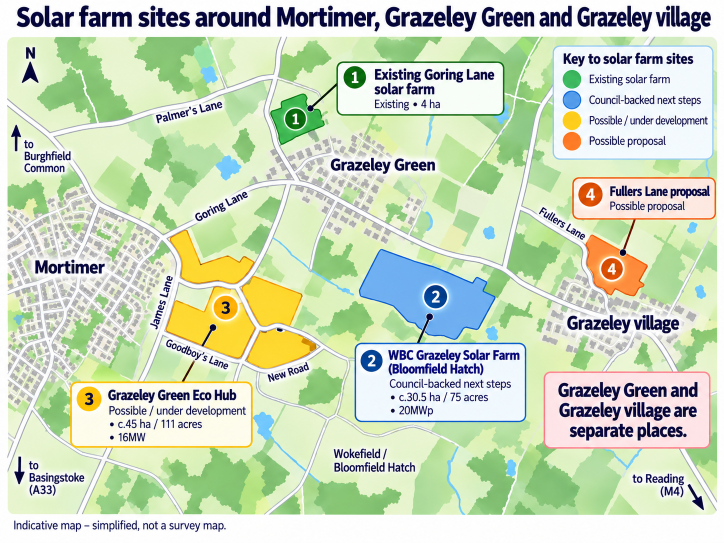
The council’s Executive agreed on 24 September to proceed with the Grazeley Solar Farm project, covering about 30.5 hectares – approximately 75 acres – at Bloomfield Hatch, south-west of Grazeley village.
The scheme aims to produce around 20 megawatts peak (MWp) of electricity, equivalent to the annual electricity use of more than 6,000 homes.
Bloomfield Hatch lies between Mortimer and Grazeley village and the proposal is separate from both the existing small solar farm near Goring Lane and other proposed solar developments around Grazeley Green.
Background
The Bloomfield Hatch project has been under consideration for several years.
A solar farm and battery storage scheme was approved in 2022. The original proposals envisaged almost 60,000 panels and a generating capacity of around 25–26MWp, with construction initially expected to start in late 2023 or early 2024. The project now being taken forward is smaller, with a capacity of 20MWp and around 35,000 panels.
During 2025 and 2026 the council reviewed the business case after higher borrowing costs and falling wholesale prices for renewable electricity affected the projected return, and decided to pause the scheme before a contractor was appointed.
The latest review considered updated construction costs, borrowing conditions, electricity prices and options for using or selling the electricity locally. An independent review by sustainability specialists Global City Futures concluded that the project remained viable and supported its continuation.
The council now estimates the project will cost around £16.2 million.
What happens next?
Following the 24 September decision, council officers will continue with procurement, any necessary planning variation work, grid-connection requirements and arrangements for the land and electricity cable route.
Who will benefit?
The scheme will be owned and operated by West Berkshire Council. After maintenance, operating costs and repayment of the finance, the council expects it to generate a modest annual surplus, which it says will help support environmental work and other council services.
Earlier versions of the project considered supplying electricity directly to AWE Burghfield, but the new plan does not assume that. The council says it will also investigate allowing residents to invest in the solar farm – described as community “buy-in” – and look at selling some of the electricity generated locally rather than simply exporting it to the grid.
The land itself is described by the council as Grade 3b agricultural land, which is below the Grades 1, 2 and 3a classified as the country’s “best and most versatile” farmland. The council says agricultural use could resume when the solar farm is eventually decommissioned.
Other local solar schemes
The Bloomfield Hatch scheme is just one of several existing and proposed developments in the area.
The existing Goring Lane solar farm, north of Goring Lane at Grazeley Green, is much smaller at around 4 hectares – just under 10 acres. It was approved in 2014 as part of a farm-diversification scheme and occupies land that was predominantly Grade 4 agricultural land.
A separate Grazeley Green Eco Hub is under development. Its promoters describe a site of approximately 45 hectares – around 111 acres – across three parcels north and south of Goring Lane, with a proposed 16MW solar installation, battery storage and electric-vehicle charging. Unlike the council project, its promoter has proposed a dedicated community benefit fund of more than £300,000 over its planned 40-year life.
There was also a consultation on a private solar farm proposal on land adjoining Fullers Lane, Grazeley.The council’s Executive agreed on 24 September to proceed with Grazeley Solar Farm, covering about 30.5 hectares – approximately 75 acres – at Bloomfield Hatch, south-west of Grazeley village.