I’ve created this page as a West Berkshire ward councillor to share information, help explain the cross-boundary context and how you can take part. The emerging Local Plan and the housing allocation within it is led by Basingstoke & Deane Borough Council and subject to independent examination.

Proposed Housing at West End Farm, Mortimer West End

Information, background and answers to common questions

Page created · last updated

Skip to FAQs ↓

Indicative location of the proposed 350 homes (as shown in B&DBC’s draft plan)

Background

Basingstoke & Deane Borough Council (BDBC) has identified land at West End Farm, Mortimer West End as a potential site for around 350 homes in its Local Plan Update (2024–2042). The site sits immediately beside Mortimer (West Berkshire) and would function as a large extension of it. This page brings together information, maps and answers to common questions about the proposal and planning process.

Jump to latest updates ↓

Having your say

Basingstoke & Deane Borough Council has published its draft Local Plan Update for Regulation 18 consultation. The consultation ran for 8 weeks ending at 5pm on 23 January 2026.

Comments submitted during the consultation period were formally recorded and are now being analysed.

Suggested approach

  1. Understand the proposal: Review the background information, maps and FAQs on this page, along with any published evidence.
  2. Ask questions of Basingstoke & Deane: Residents can speak directly with B&DBC officers at drop-in events (including the Mortimer session on Wednesday 7 January) before finalising their comments.
  3. Submit your response: Send your individual consultation response to B&DBC before the 23 January deadline. Online submission is usually the simplest option, but email and post are available as well.
Step-by-step guide (more detail)
  1. Review the information: Start with the background on this page, including the FAQs, to understand what is being consulted on and what has (and has not) been decided.
  2. Understand what you are commenting on: Regulation 18 is an early “issues and options” stage. It is your chance to raise planning and infrastructure concerns (and to point to alternatives) while the plan is still being shaped.
  3. Focus on planning points: The most effective comments tend to relate to infrastructure capacity, transport, environment, flood risk/drainage, deliverability, emergency planning considerations, and whether reasonable alternatives perform better.
  4. Be specific: Where possible, refer to the relevant section of the draft plan, evidence document, map, or policy. Short, clear points are usually more persuasive than long narratives.
  5. Submit in your own words: Templates can help people get started, but individually written responses are generally more effective. You can agree with parts, disagree with parts, or suggest changes.
  6. Submit before the deadline: Use the official consultation route so your view is recorded. (If the portal allows editing, it will usually say so — otherwise treat your submission as final.)

West Berkshire Council officers have advised that residents may find it helpful to read the relevant Basingstoke & Deane consultation documents directly, including the draft spatial strategy and supporting material published as part of the Regulation 18 consultation.

👉 B&DBC consultation documents and how to respond ↗

Basingstoke & Deane prefers responses to be submitted online, but email and postal submissions are also accepted. If you need help understanding the process or finding the right information, you can contact me or Stratfield Mortimer Parish Council.

Tip: if you attended the 7 January drop-in, you may wish to reflect any answers you received when preparing your consultation response.

Key documents and sources

These links are provided as sources residents may find helpful. They are not required reading.

For the latest timeline and event details, see the News & Updates section.

👉 Basingstoke & Deane Local Plan Regulation 18 consultation documents ↗

The News & Updates section highlights key developments and events.

Key dates

  • 28 Nov 2025 – Regulation 18 consultation opens
  • 7 Jan 2026 – B&DBC drop-in event(s) in Mortimer
  • 23 Jan 2026 (5pm) – Consultation closed

Petition

Petition closed & submitted as part of the Regulation 18 consultation.

823
signatures submitted

Submitted: 23 January 2026

See latest updates ↓

News & Updates

23 Jan 2026

Regulation 18 consultation has now closed

The Basingstoke & Deane Local Plan Regulation 18 consultation has now ended (5pm today). Thank you to everyone who took the time to submit a representation.

Basingstoke & Deane will now review the consultation feedback and published evidence before deciding whether to amend the draft plan ahead of the next stage.

👉 Official consultation information and next steps: https://www.basingstoke.gov.uk/dlp-reg18-consultation-2025

22 Dec 2025

Basingstoke & Deane officer response on Mortimer West End proposal

I’ve received a response via Alex Brewer MP, who passed on a written reply from Basingstoke & Deane Borough Council’s Planning Policy team setting out their reasoning for including land at West End Farm, Mortimer West End in the draft Local Plan.

The officer response explains the council’s spatial strategy, how Mortimer is assessed within the settlement hierarchy, and how cross-boundary impacts are expected to be considered, including reference to ongoing engagement and potential mitigation through Section 106 and CIL arrangements.

For transparency, and to help residents prepare their own representations, the officer response is published in full below.

View the officer response ↓

Basingstoke & Deane officer response (via MP for Basingstoke)

The following response was provided by Basingstoke & Deane Borough Council’s Planning Policy team, passed on via Alex Brewer MP.


Thank you for your email regarding Land at West End Farm.

I am replying on behalf of Russell and apologies for the late response. The comments were shared prior to the consultation and have been noted. I hope that interested parties take the opportunity to make formal representations in response to the current consultation which is running for 8 weeks and will end on 23 January 2026.

As part of this consultation, the council will be holding an exhibition in Mortimer to discuss the draft plans in more detail with local residents. The consultation is an opportunity for the community and others to submit formal comments to the council so issues can be considered before the publication of a further draft plan next year.

Spatial strategy and site selection

The updated spatial strategy continues to focus on Basingstoke as the most sustainable location in the borough, with an emphasis on making the best use of brownfield land (neighbourhood renewal, Basing View and Town Centre), proposed urban extensions to the east and west, in addition to a number of smaller allocations around the town to ensure a mix of sites are available to deliver the required supply of housing in the shorter term. There are also two new settlements proposed, one at Popham Airfield and one at Upper Swallick south of Basingstoke.

Settlement hierarchy and Mortimer

As part of the Local Plan process, the council has considered the sustainability of rural settlements within and near the borough through its Settlement Study. This includes an assessment of the sustainability of all settlements, taking into account several factors, including the range of facilities, services, and transport links available.

Mortimer is recognised as a Rural Service Centre in the West Berkshire Local Plan, identifying it as a larger rural settlement with a good range of key services and reasonable accessibility and regular public transport links to a number of destinations. In terms of the council’s Settlement Study, Mortimer is comparable to a category 3 settlement in the settlement hierarchy, akin to Kingsclere and Bramley, and therefore is considered suitable to accommodate additional development.

Through the detailed site assessment process the site itself was considered to be suitable for development. This took into account such issues as landscape impact, flooding, and relationship to settlement pattern. Relevant documents have been published as part of the current consultation.

Housing need

The draft plan includes a supply of housing to meet the housing need figures required through national guidance and does not identify a housing supply significantly above this need (1,152 homes each year). The site would help the borough to meet its requirement, contributing to the mix of sites (both in terms of scale and location) to ensure an ongoing supply of homes over the plan period.

Duty to Cooperate and mitigation

In line with the current Duty to Cooperate, on-going engagement is taking place with officers at West Berkshire Council to discuss cross boundary issues. The Plan remains in its early stages though and the new proposal only became public in September. Further work can now take place with West Berkshire Council and other stakeholders, including the Local Education Authority, to consider the details of the draft proposals more fully, in line with duty to co-operate principles. Whilst government has indicated that this duty will soon be removed, the council is committed to maintaining effective co-operation with neighbouring authorities and communities to ensure the best outcomes are reached.

The impact of development on Mortimer, as a settlement lying outside the borough, is recognised and consideration is being given to how the impact of development can be suitably mitigated, including through the application of Section 106 and CIL arrangements.

Kind regards
Joanne Brombley
Planning Policy Manager
Basingstoke and Deane Borough Council

How this may help when preparing a representation

  • The response explains why B&DBC considers Mortimer suitable for additional development, including reliance on its classification in the West Berkshire Local Plan.
  • It sets out how cross-boundary impacts are expected to be considered, including ongoing engagement and potential Section 106 / CIL contributions.
  • Residents may wish to consider whether these assumptions are supported by evidence, and whether the proposed approach adequately addresses local infrastructure, services, transport and environmental constraints.
10 Dec 2026

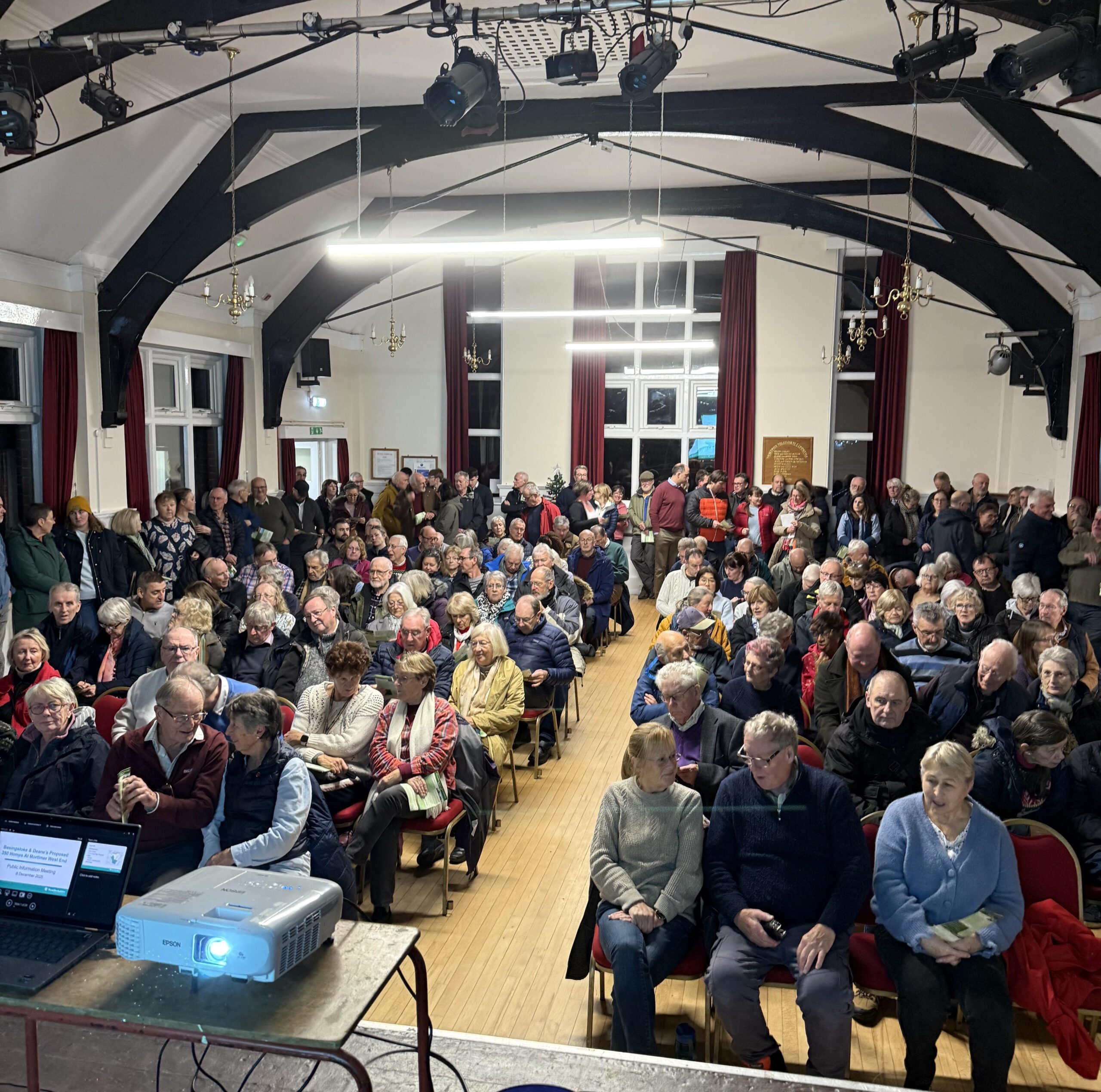
Strong turnout at public meeting on Mortimer West End proposal

There was a strong turnout for Monday’s West Berkshire Council public meeting on Basingstoke & Deane Borough Council’s proposal for around 350 homes at West End Farm, Mortimer West End. The session was chaired by Cllr Nick Carter, ward member for Burghfield & Mortimer, and featured a panel comprising:

  • Cllr Jeff Brooks, Leader of West Berkshire Council
  • Cllr Denise Gaines, Executive Member for Planning & Housing
  • Laura Callan, Service Lead for Planning
  • Paula Amorelli, Team Lead for Development & Planning
  • Members of Stratfield Mortimer Parish Council’s Steering Group

Their insights – together with residents’ questions and contributions – helped create a constructive and informative discussion about the proposal, the Local Plan process, and how residents can influence the outcome.

The night’s presentation is available here: download the slides ↗. That’s TV Thames Valley (Freeview channel 7) also covered the meeting – you can watch their report here: TV report ↗.

Olivia Bailey’s office has also been in touch to ask how she can support residents on this issue. I’ll share further updates once we’ve followed up on specific next steps.

What residents can do next

  1. Sign the petition – and share it.
    Every individual signature matters.
    👉 Sign the petition online ↗
  2. Review the toolkit on this page.
    The FAQs and objection toolkit below bring together: links to Basingstoke & Deane’s consultation documents, example response structures, and Stratfield Mortimer Parish Council’s prepared responses.
  3. Attend Basingstoke & Deane’s drop-in session – 7 January.
    📍 St John’s Village Hall, 22 West End Road, RG7 3TF
    🕒 3.30pm – 8.00pm on Wednesday 7 January 2026
    This is your opportunity to speak directly to Basingstoke & Deane officers, ask questions, and clarify points before finalising your consultation response.
  4. Submit your individual response before 23 January 2026.
    The online consultation portal is here: www.basingstoke.gov.uk/dlp-have-your-say ↗ . If you cannot access the internet, paper forms are available from Basingstoke & Deane’s Civic Offices or by calling 01256 844844. Completed forms can be returned by post or by hand to: Local Plan, Civic Offices, London Road, Basingstoke, RG21 4AH.

If you have questions before responding – or would like help navigating the consultation documents – please feel free to get in touch.

Residents attending the West Berkshire Council public meeting in Mortimer on 8 December 2025
Residents at the public information meeting in St John’s Village Hall, 8 December 2025.

    28 Nov 2025

    Regulation 18 consultation opens – local information sessions announced

    Basingstoke & Deane Borough Council has now launched its Regulation 18 consultation on the draft Local Plan and updated spatial strategy. The consultation runs from Friday 28 November 2025 to Friday 23 January 2026.

    You can read the draft Local Plan and submit comments via Basingstoke & Deane’s online portal: www.basingstoke.gov.uk/draftLP . Responses made at any point during the consultation window carry the same weight, so there is no need to respond immediately if you would find it helpful to hear more first.

    Local information and Q&A sessions

    • Mon 8 Dec 2025 – 7.30pm, St John’s Village Hall, 22 West End Road, RG7 3TF
      An information meeting organised by the ward members, with the Leader of West Berkshire Council, the Executive Member for Planning & Housing and a senior planning officer attending. The aim is to explain the plan-making process, cross-boundary context and how to make effective consultation responses, followed by a Q&A session. Parish councils and the working group have been invited to attend and a representative to speak. Full event details: see event listing ↗ .
    • Tue 7 Jan 2026 – 3.30pm to 8.00pm, St John’s Village Hall, 22 West End Road, RG7 3TF
      A Basingstoke & Deane Borough Council drop-in event, where residents can discuss the draft Plan, evidence base and mapping directly with B&DBC officers during the consultation period.

    A parish working-group evidence pack and guidance are expected in due course; links will be added to this page when they are publicly available. In the meantime, you may find it helpful to use the Frequently Asked Questions and the Objection toolkit on this page to start drafting ideas and points in your own words, and then finalise your representation after one or both of the above sessions.

    25 Nov 2025

    Public information meeting – West End Farm proposals (8 December)

    Basingstoke & Deane Borough Council’s Regulation 18 consultation on its draft Local Plan opens on Friday 28 November 2025. West Berkshire ward councillors are organising a local information session to help residents understand the process and how to respond effectively.

    Date: Monday 8 December 2025
    Time: 7.30pm
    Venue: St John’s Village Hall, 22 West End Road, Mortimer RG7 3TF

    We are pleased that the Leader of West Berkshire Council, the Executive Member for Planning & Housing and a senior member of the Planning team will be attending to explain the plan-making process, clarify how cross-boundary issues are considered, and answer residents’ questions. The parish council has been invited to attend and contribute. More details on the meeting format will follow, but you will have a chance to participate.

     
        21 Nov 2025    

    Regulation 18 consultation to open on 28 November


        Basingstoke & Deane Borough Council has announced that its     Regulation 18 consultation on the draft Local Plan Update     — including the proposed 350 homes at West End Farm, Mortimer West End —     will open on Friday 28 November 2025.  


        The consultation will run for eight weeks until Friday 23 January 2026.     When it opens, B&DBC will publish full documents and the link to their online     consultation portal, where residents can read the draft plan and submit formal comments.  


        B&DBC have also indicated they will hold in-person drop-in events in January,     with dates and venues to be confirmed when the consultation launches.  


        You do not need to submit comments before 28 November.     Any representations must be made through the official consultation portal once it opens.  

    Update (24 Nov 2025): B&DBC has confirmed that the Regulation 18 consultation will run from 28 November 2025 to 23 January 2026, with local drop-in events planned for early January. This page will be updated again when venue and timing are confirmed.

    11 Nov 2025

    Cabinet hears representations and agrees to consult on draft Local Plan

    On 11 November 2025, Basingstoke & Deane’s Cabinet considered whether to publish its draft Local Plan Update (including the West End Farm site) for formal Regulation 18 consultation. The meeting heard representations from residents, Basingstoke & Deane councillors and me as a West Berkshire councillor.

    After debate, the Cabinet agreed to put the draft plan out for consultation. That consultation is expected to open this month and run for eight weeks, with drop-in event(s) in Mortimer. You can still sign the petition (which I intend to re-submit at Regulation 18) and read the background information referenced on this page. If you wish to make a formal representation, it is usually best to do so once the Regulation 18 consultation opens, via the official consultation route so that your response is logged formally.

    Cllr Nick Carter’s statement (11 Nov 2025) – example of structure and issues: PDF

    Watch key sections from the meeting:

    • Discussion starts — timestamp
    • Mortimer petition & my representation — timestamp
    • Cllr Konieczko’s response to representations — timestamp
    13 Nov 2025

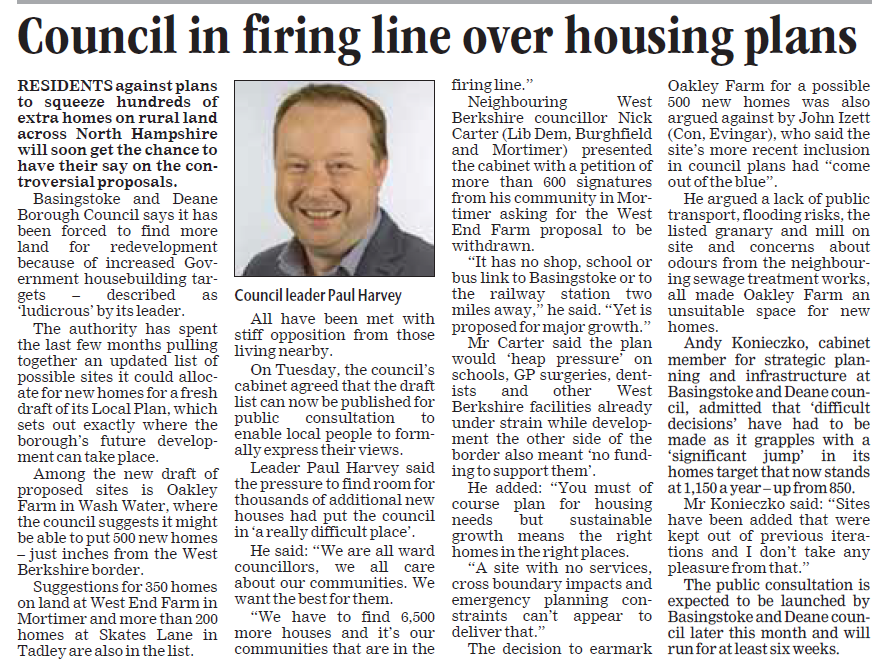
    Local press reports on Cabinet decision

    Local newspaper coverage of the Basingstoke & Deane Cabinet meeting on 11 November 2025
    Newbury Weekly News coverage following B&DBC’s 11 November Cabinet meeting.

    The Newbury Weekly News reported on Basingstoke & Deane Borough Council’s Cabinet meeting of 11 November 2025, including discussion of the draft Local Plan Update and the proposed allocation at West End Farm, Mortimer West End.

    The article summarised the council’s approach and highlighted the inclusion of Mortimer West End within the draft plan ahead of the Regulation 18 consultation.

    Read the article in full ↗

    25 Oct 2025

    Parish meeting

    The parish council held a public meeting to discuss the topic. Over 250 residents attended. I couldn't make it, so submitted in a statement which was read out. The minutes are HERE (PDF). My statement is here: Cllr Nick’s statement (PDF).

    Oct 2025

    Introduction and background

    Why the West End Farm site has appeared in Basingstoke & Deane’s Local Plan Update and what it could mean for Mortimer West End and Mortimer. Read the full article ↗

Resources

Objection & response toolkit

How to use this page: If you want to comment on Basingstoke & Deane’s draft Local Plan, the most effective response is an individual one in your own words, focused on planning issues (not just how strongly you feel).

  • Start with the official documents – Basingstoke & Deane’s Regulation 18 consultation pages and consultation portal set out the draft policies and evidence base.
  • Use this page as a signpost to key evidence (committee reports, impact assessments) and the FAQs / objection toolkit below, which explain issues like infrastructure, emergency planning, agricultural land and local character.
  • Refer to Stratfield Mortimer Parish Council’s toolkit for their prepared themes and example wording. It can be a helpful checklist, but it is not a script – please avoid copying text verbatim.

The example letter linked below, sent earlier in the process, is shared only to illustrate structure, tone and the types of planning themes you might raise. It is not a recommended template for responses at Regulation 18.

In general, individually written representations that draw on the evidence carry more weight than copied or standardised letters.

Frequently Asked Questions

1) What is a Local Plan and what does it do?

A Local Plan sets out how much development an area needs and where it should go over a 15-year period. It identifies housing sites, infrastructure, and environmental protections, and guides future planning decisions.

2) Are 350 homes definitely being built in Mortimer West End/who decides if the site is allocated?

The land is a candidate for housing in Basingstoke & Deane Borough Council’s draft Local Plan. There are several stages it must pass through before it could be included in the final plan, starting with the current Regulation 18 consultation.

After that closes, B&DBC will review the feedback received. If it decides to keep the site in its draft plan, it will progress to a stage called Regulation 19, and potentially on to examination by an Inspector. The process is described in more detail here.

The Local Plan and its proposed site allocations are then examined by an independent Planning Inspector, who will test whether the plan is sound. This includes assessing the evidence on matters such as environmental impact, infrastructure capacity, transport, and deliverability.

Only if the Inspector finds the plan to be sound can it be adopted. Further explanation of the Local Plan process is set out in a presentation prepared by West Berkshire Council officers, which is linked elsewhere on this page.

3) Is there enough infrastructure for 350 new homes and, assuming not, who pays to improve it?

This is a key question that the Local Plan process must answer. Before any housing allocation can be confirmed, Basingstoke & Deane Borough Council (BDBC) must work with:

  • Hampshire County Council – schools, highways and transport
  • West Berkshire Council – education authority, highways and transport
  • NHS Integrated Care Board – GP and health services
  • Utility companies – drainage, water and energy

Together they assess whether and how local infrastructure can support the proposed housing level — particularly its impact on school capacity, GP services, roads,parking, public transport and drainage. BDBC’s evidence base must demonstrate that these needs can be met and funded before a site is allocated.

Infrastructure is normally funded through Community Infrastructure Levy (CIL) and Section 106 (S106) agreements with the developer:

  • CIL is a general charge on new floorspace collected by the charging authority (here, BDBC). A portion goes to parishes within BDBC, but it does not automatically flow to West Berkshire because the houses would be in Hampshire.
  • S106 is site-specific and can fund mitigation where directly justified — e.g., junction improvements or contributions to school or health capacity. Cross-boundary impacts are handled through engagement and Statements of Common Ground.

If Mortimer GP Surgery cannot absorb additional patients, any expansion or new provision would have to be led by the NHS Integrated Care Board and the practice with evidence of need. S106 funds could contribute if justified, but CIL spending is at BDBC’s discretion within its area.

👉 Use this when objecting on infrastructure deliverability and funding (schools, GP capacity, access, drainage).

4) Which schools would children likely attend, and is school transport funded?

Children from any new housing at Mortimer West End would be expected to attend schools according to the relevant education authority’s admissions policies. In practice, this is likely to include schools in West Berkshire, as Mortimer village and its schools are closer than alternatives within Basingstoke & Deane.

However, proximity alone does not guarantee places. Whether schools can accommodate additional pupils depends on current and forecast capacity, which must be assessed as part of the Local Plan evidence.

Where development creates additional demand for school places, developer contributions through Section 106 may be sought to help fund expansions or mitigation. This can include cross-boundary provision, but only where the impact is clearly evidenced and agreed between authorities.

School transport is not automatically funded. Eligibility depends on statutory distance thresholds, route safety, and the policies of the education authority responsible. If children are attending schools in a neighbouring authority, transport funding arrangements are more complex and are not guaranteed.

For this reason, the Local Plan must demonstrate not just that schools exist, but that capacity, funding, and access arrangements are realistic and deliverable before the site can be considered sound.

👉 Use this when objecting on school capacity, education funding, or transport practicality.

5) If this site is allocated, does it automatically mean more housing will follow?

No. Allocation of a site in a Local Plan does not create an automatic right for further development beyond what is specified.

Each housing allocation is assessed individually against the Local Plan’s spatial strategy, settlement hierarchy, environmental constraints, and infrastructure capacity. Any additional land would require its own evidence, consultation, and allocation through a future plan review.

Importantly, the Local Plan must demonstrate that development boundaries, settlement separation, and landscape constraints are being respected. Approval of one site does not weaken those policies or remove the need for future proposals to be justified on their own merits.

Claims that allocation of this site would make further development “inevitable” are therefore assumptions, not planning fact.

This is why it is important that representations focus on evidence, sustainability, and deliverability, rather than speculation about what might happen in the future.

👉 Use this when responding to claims about “salami slicing” or inevitable expansion.

6) Does Basingstoke & Deane need to allocate the Mortimer West End site to meeting its housing numbers?

The Government sets out, via a calculation, a minimum local housing need, for each council area. It's not a fixed building target. Councils obtain from landownders a pool of sites, ideally larger than the "need" to allow for flexibility (non-delivery, infrastructure phasing, environmental limits). It appears that Basingstoke and Deane's total pool is below the calcuulated "need" level. Which sites make the final plan is a policy choice that must be justified by evidence and pass the Inspector’s soundness tests. It's possible to suggest alternative sites be considered, be those that are currently referenced in the documentation as excluded (for example two sites in Tadley) or land not current put forward.

.

A site's suitability will depend on issues such as: landscape/heritage effects, ecology (including protected sites/species), flood risk and drainage, highway safety and network capacity, health/education/service capacity, air/noise, emergency planning, deliverability/viability, and whether reasonable alternatives perform better in the Sustainability Appraisal.

How could an Inspector conclude this site is not needed?

  • (a) No allocation appropriate here: If evidence shows BDBC’s overall requirement can be met by other more suitable/deliverable; the Sustainability Appraisal shows reasonable alternatives with fewer impacts; infrastructure constraints are not realistically solvable in the plan period). In that scenario, the allocation might be removed without undermining the plan’s housing trajectory.
  • (b) A smaller allocation is appropriate: The site might be retained at a reduced capacity if landscape, access, emergency-planning or infrastructure evidence supports a lower, more “village-edge” scale with stronger design/green-gap measures. This situation might rely on other sites being put forward to make up the shortfall.

What about Traveller pitches if the housing changes?

  • If the allocation is removed, BDBC still must meet any Gypsy & Traveller need identified by its GTAA. That can be done by: modest extensions to existing authorised sites, placing pitches with other large housing allocations that are better served by roads and services, or (if justified) a small standalone site elsewhere.
  • If the allocation is reduced, pitches might still be included—but residents can seek a cap, stronger design/screening, and tests of whether co-location would be more proportionate at other strategic sites with higher service accessibility.

👉 Use this when objecting on reasonable alternatives and soundness—ask BDBC to select less impactful, better-served sites if the candidate pool allows and evidence supports it.

7) Is this proposal an extension of Mortimer?

Whilst it's described as such in Basingstoke & Deane Borough Council and is seen as doing so for practical purposes, the site is in Hampshire, within Mortimer West End Parish, in Hampshire. Although the homes would adjoin Mortimer, and the plan places reliance on West Berkshire services, the site remains under Basingstoke & DeaneBDBC and Hampshire County Council in local government terms.

8) When should residents submit their views?

Residents can submit views at any point during the Regulation 18 consultation period - it closed at 5pm on Friday 23 January 2026. Comments submitted during the period are considered in the same way irrespective of when they were sent in.

9) Can consultation responses be edited after submission?

No. You can edit them beforehand. Whilst you can send in a second submission, it's better to do it as a single one, ideally with comments linked to the relevant sections of the consultation, to make it easier for staff to analyise.

10) Who should I contact with process queries?
11) I see Mortimer dentist has been offered land for a new practice — will that help meet extra need for dentistry?

It should increase private provision private, but they do not appear to offer NHS capacity.

12) What types of comments are most effective?

Responses that focus on planning considerations are most effective. These include infrastructure capacity, transport, environmental impact, flood risk, access, health and education provision, deliverability, funding and whether reasonable alternative sites perform better. Whilst a Planning Inspector might note/comment on the volume of comments, it's objective Planning considerations that ultimately he or she will use to decide whether to approve the Plan (with or without modifications) in the end. It's quality over quantity of comments.

13) Can a petition kill the plan?

Petitions, like demonstrations, can show strength of feeling. WBC staff have suggested that they are more effective when coupled with individual response that are based on Planning grounds. Resident who feel strongly about this are advised to submit their own consultation response in addition to signing a petition or demonstrating. It's not an either/or.

14) Does high volumes of consultation responses affect the likelihood of the site's removal from the Local Plan?

No. Whilst volume of comments, like a petition, can show strength of feeling, responses will be judged on planning grounds. Equally whilst a Planning inspector might note or even comment on volume of comments made later, he/she will by that time be focussed on whether the plan before him/her is legally valid.

15) What happens after the consultation closes?

The council reviews all submissions, publishes a consultation summary, and may revise the draft plan. The plan then proceeds to independent examination before any final decision is made.

16) How might the Policy Alignment Test and the Stratfield Mortimer Neighbourhood Plan influence this proposal?

The old legal Duty to Co-operate has been replaced in the National Planning Policy Framework by a Policy Alignment Test. BDBC and West Berkshire are still expected to engage constructively across the boundary, agree evidence, and set out how cross-boundary impacts are managed (typically via Statements of Common Ground).

Whilst BDBC is not obliged to follow policies written in Stratfield Mortimer Neighbourhood Plan (e.g., mix, height, density), that Plan is a so-called "material" consideration. The NPPF expects context-sensitive design and gentle edge transitions. A refreshed Neighbourhood Plan and/or a simple design code can therefore be influential if they are:

  • evidence-based (landscape/heritage/setting, transport, drainage, local character),
  • specific but reasonable (edge treatments, building heights, block layout principles, green gaps, active travel links), and
  • presented through the Reg 18/19 process and discussed for inclusion in a Statement of Common Ground and site-specific policy wording.

Bottom line: a coordinated parish position (both sides of the border), backed by design-led, proportionate evidence, can shape any allocation’s form and phasing—even if it cannot veto it outright.

17) Is the site affected by AWE emergency planning zones (DEPZ) that could stop development?

The land at West End Farm lies outside the formal Detailed Emergency Planning Zones (DEPZs) set by the Office for Nuclear Regulation (ONR) for AWE Burghfield and AWE Aldermaston. The DEPZ is a single national boundary that spans local authority areas (WBC and BDBC do not have different DEPZs).

Although the houses lie outside the DEPZ so ONR may not automatically object, the DEPZ can change over time and local mapping indicates the site lies within Outline Planning Zones (OPZs). Any proposal here would still need to satisfy emergency-planning considerations — such as evacuation routes, access for emergency services, and public-information duties. Given the scale of the proposed housing, this remains an important issue to raise in any objection or consultation response. The ONR and emergency-planning authorities will be consulted formally if the site progresses further.

18) Would all 350 houses actually fit — and would they be in keeping with Mortimer?

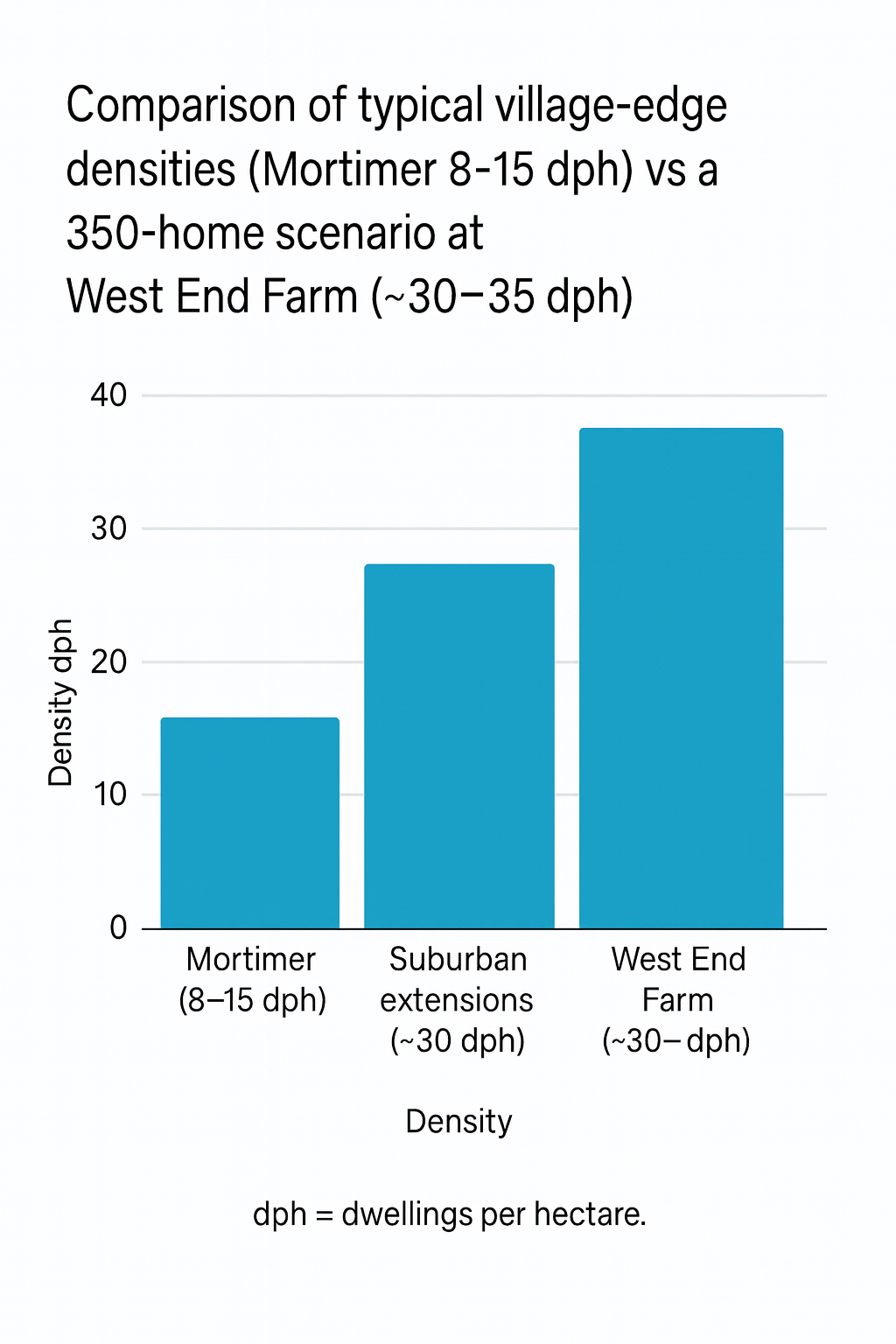
This is an area that the ward councillor and council staff are looking at, given the plot size and the rural housing density of the existing hamlet and Mortimer. A housing density of 30–35 dph (dwellings per hectare), exceeds the 20–25 dph density in most of Mortimer and may flout the Mortimer Neighbourhood Plan that refers to the village’s edges as being “gentle transition zones.” Older parts of Mortimer average nearer 15–20 dph, while newer infill estates reach 27–30 dph.

Illustrative comparison: Mortimer character densities vs West End Farm scenario
Comparison of typical Mortimer character densities and the West End Farm 350-home scenario. dph = dwellings per hectare.

On a developable area of roughly 10–11 hectares, the relationship between density and housing numbers is approximately:

  • 15 dph – 150–165 homes (rural-edge character);
  • 20 dph – 200–220 homes (village-edge pattern);
  • 25 dph – 250–275 homes (balanced, mixed layout);
  • 30 dph – 300–330 homes (suburban/estate character);
  • 35 dph – 350–385 homes (urban edge scale).

A layout closer to 20–25 dph would better reflect Mortimer’s prevailing pattern, still allowing a mix of 2-, 3- and 4-bed homes, affordable housing and about 5 % self-build plots (as mentioned in BDBC’s draft plan), while providing a softer visual and landscape transition to the countryside.

👉 Use this when objecting on character, scale and design-fit grounds — it demonstrates that a full 350-home scheme would exceed typical village-edge density and alter local character.

19) What’s the situation with Traveller (Gypsy & Traveller) sites — and why suggest one here?

BDBC’s Local Plan Update includes provision for Gypsy & Traveller pitches across the borough. National policy expects councils to plan for an identified need, usually set by a Gypsy & Traveller Accommodation Assessment (GTAA). Pitches can be provided on small dedicated sites, as extensions to existing authorised ones, or occasionally co-located with larger housing sites to encourage integration.

At this early stage, BDBC has indicated that the West End Farm allocation could include some Traveller provision, but no confirmed number of pitches has yet been published. The final location and scale will depend on the GTAA and supporting evidence.

National planning guidance emphasises that new sites should be well-located for services, have safe access, and promote good relations with local communities. Equally, they should avoid areas with unsuitable access, flood risk or poor integration.

If you wish to comment or object, as with all other aspects, you're advised to focus on planning grounds: consider asking BDBC to publish the GTAA and site-selection evidence; explain why this site is considered preferable to modest extensions of existing sites; and test co-location at other strategic housing allocations closer to services or higher-capacity roads. Comments are best to made respectfully and considering location, access, design, screening, proportionality and integration.

👉 Use this when objecting on site selection and proportionality grounds (request publication of GTAA evidence and comparison of alternatives).

How does the nearby West Berkshire site factor in? West Berkshire’s provision does not discharge BDBC’s duty to meet its own need. However, when BDBC selects locations, it should consider distribution and cumulative impact—i.e., avoiding over-concentration in one locality, ensuring proportional access to services, and maintaining good relations through well-designed, integrated sites. These are planning-merit points residents can raise respectfully, focusing on location, access, design and proportionality—not on people.

More questions? Email Cllr Nick Carter.

Objection toolkit

Before starting: The points below are intended to help you understand planning issues and structure your thinking. They are not a template and should not be copied as a standard letter.

A parish-led working group is currently preparing additional evidence and guidance. Once it is formally published, it will be linked here. You may find it helpful to draft ideas now, then finalise your submission after:

  • the Regulation 18 consultation documents are issued;
  • parish evidence packs are publicly released;
  • B&DBC drop-in events and Q&A sessions have taken place.

Representations should be in your own words and reflect your understanding, location, experience and concerns. Identical letters carry much less weight.

When drafting your response, you may find these FAQs helpful:

Before the Regulation 18 consultation opens, you can still share views by emailing Cllr Konieczko, Cabinet Member for Planning, and, ideally, copying me in so I am aware of the points you are raising.

Once the Regulation 18 consultation is officially open, the most effective way to comment is to use the official consultation route provided by Basingstoke & Deane Borough Council, so that your representation is logged formally and considered alongside the evidence.

You can also refer to Cllr Nick Carter’s example response for structure and tone.

Key stages and dates (subject to change)

  • 4 Sept 2025 B&DBC reviews candidate sites incl. West End Farm
  • 11 Nov 2025 B&DBC Cabinet agrees to publish draft Local Plan (incl. West End Farm) for Reg 18 consultation
  • 21 Nov 2025 B&DBC announces dates for Reg 18 consultation (28 Nov 2025–23 Jan 2026)
  • 28 Nov 2025 Regulation 18 consultation opens (8 weeks to 23 Jan 2026)
  • 8 Dec 2025 West Berkshire councillors’ public information session (19:30, St John’s Village Hall, Mortimer)
  • 7 Jan 2026 B&DBC drop-in event(s) in Mortimer – time and venue to be confirmed
  • First half 2026 Regulation 19 publication & submission to Inspector (timetable indicative)
  • Late 2020s Earliest possible start of any housing (if allocated & planning permission granted)

Page created and maintained by Cllr Nick Carter, West Berkshire Council – Burghfield & Mortimer Ward.
Content last updated .

Stay Updated

If you’d like updates when Basingstoke & Deane publish new documents, when the Regulation 18 consultation opens, or when key dates change, you can sign up below. You’ll only receive occasional updates on this topic.

Your details are used only for updates about the Local Plan and West End Farm site. You can unsubscribe at any time.

Contact

Cllr Nick Carter • West Berkshire Council – Burghfield & Mortimer Ward
[email protected] · 07447 557557

Official Local Plan queries (B&DBC Planning Policy Team): [email protected]

Back to top ↑

Councillor Nick


Welcome

I represent Burghfield, Mortimer, Beech Hill & Wokefield (“Burghfield & Mortimer” ward) on West Berkshire Council. I use this page to share updates, explain how things work, and point you towards ways to get help or have your say.

Introduction

West Berkshire Council is a unitary authority, responsible for services such as housing, waste and recycling, council tax, education, libraries, social care, transport, planning, licensing, consumer protection and cemeteries/crematoria. I work with council staff and fellow councillors to try to meet resident needs, inform and improve services. My online newsletter provides updates on key decisions, local issues and ways to get involved. You can sign up below. My contact details, social media and useful info are listed underneath the back issues list.

Subscribe here

To receive my newsletter by email, simply write your details below. You can unsubscribe at any time.

Newsletter 13

Speed Limits, Bus Services, Waste & Recycling, Ridgeway Council, Road Improvements. Read it HERE

Newsletter 12

Mortimer Post Office, Grazeley Solar Farm, Fairground Water Supply, Bus & Speed Limit Survey, Waste & Recycling and more. Read it HERE

Newsletter 11

Windmill Court, a Bus & Speed Limit Survey, Council Budget, Waste & Recycling, Grazeley Solar Farm and more. Read it HERE

Newsletter 10

Burghfield Skate Park 2.0, Pavement Outside St John’s Mortimer, Council Budget, Bus Service Review and more. Read it HERE